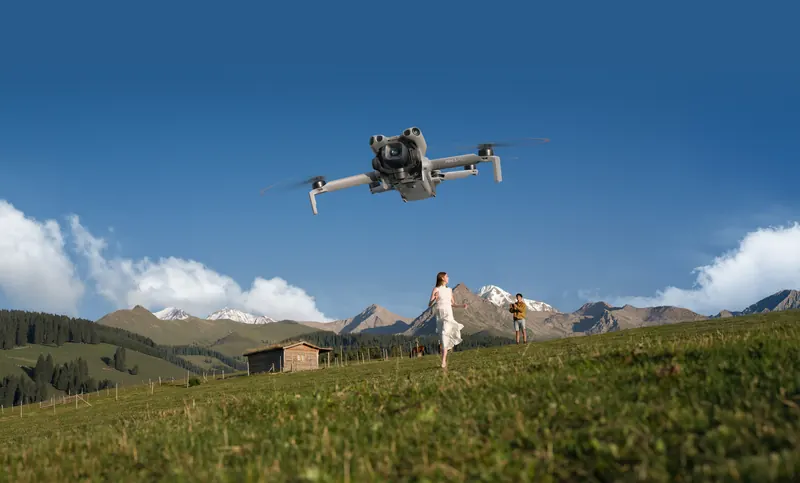
DJI Mini 5 Pro vs Mini 4 Pro
DJI gives the Mini 5 Pro a 1-inch sensor, 36 minutes of flight and Remote ID on either battery; the Mini 4 Pro has a 1/1.3-inch sensor, 34 minutes and Remote ID only with the Intelligent Flight Battery Plus.
- Image sensor, Mini 5 Pro vs Mini 4 Pro
- 1vs 1/1.3-inch
- Max flight time
- 36vs 34min
- DJI's listed weight
- 249.9vs under 249g
What DJI says changed from the Mini 4 Pro to the Mini 5 Pro
DJI's own Mini 5 Pro FAQ answers what the Mini 5 Pro improves over the Mini 4 Pro in eight points.
Here they are in DJI's figures, with the Mini 4 Pro's figure beside each from its own pages, all read November 14, 2026.
- Camera
The Mini 5 Pro introduces a 1-inch CMOS sensor and a new image processing platform, with up to 14 stops of dynamic range in HDR video. The Mini 4 Pro has a 1/1.3-inch CMOS sensor. DJI says the 14 stops apply to video in Auto mode only, not to slow motion or to the new 48mm Med-Tele mode (2x zoom).
- Gimbal
225 degrees of roll, turned by hand or through modes such as QuickShot Rotate, Timelapse, Spotlight and Waypoint Flight. The Mini 4 Pro's gimbal rolls to −90° or 0° for true vertical shooting.
- Sensing
A forward-facing LiDAR supports omnidirectional obstacle sensing at night down to 1 lux, and a next-gen Smart RTH.
- ActiveTrack
The Mini 5 Pro picks a Cycling or Standard tracking mode by the scene.
- Flight
36 minutes of max flight time against 34 minutes (52 minutes against 45 with the Intelligent Flight Battery Plus), a wind rating of 26.8 mph (12 m/s) against 23.9 mph (10.7 m/s), and 40.3 mph (18 m/s) top speed in Sport mode against 35.8 mph (16 m/s).
- Video link
DJI O4+ with up to 12.4 mi (20 km) of 10-bit video transmission under FCC rules, in an open area with no interference. The Mini 4 Pro's O4 is also rated to 12.4 mi (20 km) under FCC rules.
- Storage
42 GB of internal storage and Off-State QuickTransfer at up to 100 MB/s, against 2 GB and Wi-Fi at 30 MB/s on the Mini 4 Pro.
- Charging
One standard battery charges in about 46 minutes with the DJI 65W Portable Charger and the charging hub; the Mini 4 Pro's takes 58 minutes in its hub with the DJI 30W charger.
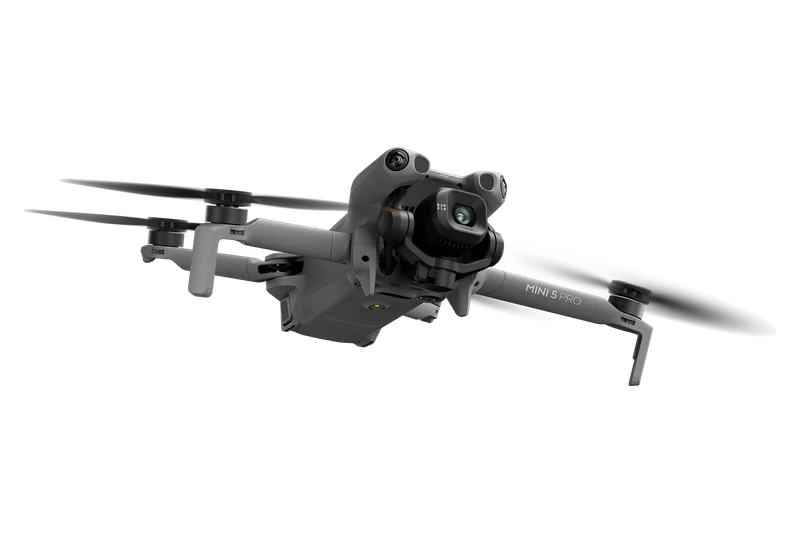
DJI Mini 5 Pro
1-inch · 36 min · 249.9 g
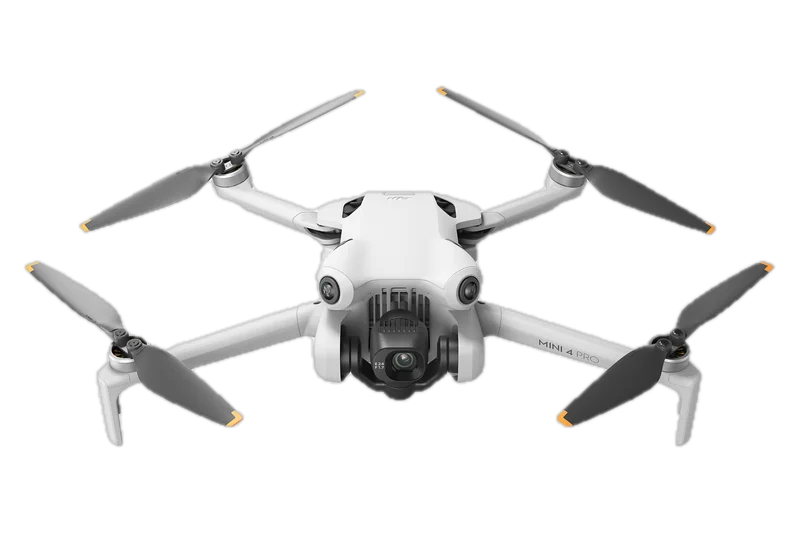
DJI Mini 4 Pro
1/1.3-inch · 34 min · under 249 g
Two figures go the other way
The Mini 5 Pro's max video bitrate is 130 Mbps against 150 Mbps on the Mini 4 Pro, and DJI lists it heavier, at 249.9 g against under 249 g. That weight is the one change that touches U.S. rules; the weight section puts it beside the regulation.
DJI Mini 4 Pro vs Mini 5 Pro: specs side by side
This table is the compare tool's own answer for the pair, built from our records of DJI's spec pages (data read November 13, 2026), so it reads the same as the tool with these two drones loaded.
One row of the tool's answer, on registration when flown for fun, is left out here: the weight section gives DJI's figure beside the rule instead.
marks the longer flight time, the higher wind rating, the wider temperature range, more internal storage, sensing in more directions, a microSD slot, or the longer FCC transmission distance. No mark where a figure is not stated or every figure is the same.
| Figure | DJI Mini 5 ProFigures from DJI's UK page | DJI Mini 4 Pro |
|---|---|---|
| Weight and U.S. rules | ||
| Takeoff weight | 0.551 lb (249.9 g)With DJI Mini 5 Pro Intelligent Flight Battery Plus: Not stated by the maker | Under 0.549 lb (249 g)With Intelligent Flight Battery Plus: Not stated by the maker |
| Remote ID, flown for fun | Broadcasts Remote ID.Record: built-in Remote ID, on the FAA list of accepted declarations | Not needed: Remote ID applies to drones that are registered or must be, and this one is neither.Record: on the FAA list, but the maker says the built-in Remote ID is on only with the Intelligent Flight Battery Plus |
| Flight | ||
| Max flight time | 36 min, longerWith DJI Mini 5 Pro Intelligent Flight Battery Plus: 52 min | 34 minWith Intelligent Flight Battery Plus: 45 min |
| Max horizontal speed | 40.3 mph (18 m/s)With DJI Mini 5 Pro Intelligent Flight Battery Plus: 42.5 mph (19 m/s) | 35.8 mph (16 m/s) |
| Max wind speed resistance | 26.8 mph, higher | 23.9 mph |
| Operating temperature | 14 to 104 °F (−10 to 40 °C) | 14 to 104 °F (−10 to 40 °C) |
| Camera and video | ||
| Image sensor | 1-inch CMOS | 1/ |
| Effective pixels | 50 MP | 48 MP |
| Video resolution | 4K: 3840×2160@ | 4K: 3840×2160@ |
| Gimbal | 3-axis | 3-axis |
| Sensing and transmission | ||
| Obstacle sensing | All directionsMaker's words: Omnidirectional binocular vision system, supplemented with forward-facing LiDAR and an infrared sensor at the bottom of the aircraft | All directionsMaker's words: Omnidirectional binocular vision system, supplemented with a 3D infrared sensor at the bottom of the aircraft |
| Max transmission distance | 12.4 mi (20 km), FCC | 12.4 mi (20 km), FCC |
| Battery | ||
| Battery capacity | 2,788 mAhWith DJI Mini 5 Pro Intelligent Flight Battery Plus: 4,680 mAh | 2,590 mAhWith Intelligent Flight Battery Plus: 3,850 mAh |
| Battery energy | 19.52 WhWith DJI Mini 5 Pro Intelligent Flight Battery Plus: 33.51 Wh | 18.96 WhWith Intelligent Flight Battery Plus: 28.4 Wh |
Show 8 more rowsShow 5 more rows
| Figure | DJI Mini 5 ProFigures from DJI's UK page | DJI Mini 4 Pro |
|---|---|---|
| Size and storage | ||
| Dimensions | Folded, without propellers: 6.2 × 3.7 × 2.7 in (157 × 95 × 68 mm)Unfolded, with propellers: 12 × 15 × 3.6 in (304 × 380 × 91 mm) | Folded, without propellers: 5.8 × 3.7 × 2.5 in (148 × 94 × 64 mm)Unfolded, with propellers: 11.7 × 14.7 × 4 in (298 × 373 × 101 mm) |
| Folds | Yes | Yes |
| Internal storage | 42 GB, more | 2 GB |
| microSD slot | Yes | Yes |
| Control | ||
| Controllers | DJI RC-N3, DJI RC 2 | DJI RC-N2, DJI RC 2 |
| Flight over people and propeller guards | ||
| Flight over people, Part 107 | Flying over people who are not taking part is allowed only if the drone fits Category 1, 2, 3 or 4. Categories 2 and 3 need a declaration of compliance the FAA has accepted; Category 4 needs an airworthiness certificate.Record: 0.551 lb (249.9 g); propeller guards sold or documented by the maker, not in the box | Flying over people who are not taking part is allowed only if the drone fits Category 1, 2, 3 or 4. Categories 2 and 3 need a declaration of compliance the FAA has accepted; Category 4 needs an airworthiness certificate.Whether this drone fits Category 1 cannot be told from its weight (0.55 lb or less): it must also have no exposed rotating parts that would cut skin.Record: under 0.549 lb (249 g); propeller guards sold or documented by the maker, not in the box |
| Propeller guards | Sold or documented by the maker, not in the box | Sold or documented by the maker, not in the box |
| Where the figures come from | ||
| Maker's documents | Figures from DJI's UK page; DJI's U.S. site has no page for this model.DJI Mini 5 Pro specs page (UK English; no U.S. page) | DJI Mini 4 Pro specs page (U.S.); DJI Mini 4 Pro product page (U.S.); DJI consumer drone comparison page (U.S.). Read 2026-11-13, 2026-11-14. |
- Under Part 107 every drone is registered, whatever its weight. So under Part 107 Remote ID applies to every drone: one without built-in Remote ID needs a broadcast module, or must stay inside an FAA-recognized identification area (FRIA).
- None of the drones in this tool, as sold, is on the FAA list of accepted declarations of compliance for flight over people (Categories 2 and 3).
- Transmission distance is the radio link's farthest reach in the open with no interference, not a legal range: flown for fun or under Part 107, the drone stays within visual line of sight.
More figures from DJI's spec pages
Figures other comparisons print that our records do not hold, each from DJI's own pages: the Mini 5 Pro specs page for Canada (DJI has no U.S. page for it), the Mini 4 Pro specs page for the U.S., and each drone's FAQ and release notes where a row says so.
| Figure | DJI Mini 5 Pro | DJI Mini 4 Pro |
|---|---|---|
| Flight | ||
| Typical flight time, DJI's test in a breeze recording 4K/60fps | 21 min (33 min with Battery Plus) | Not compared here |
| Max hovering time | Not printed by DJI | 30 min (39 min with Battery Plus) |
| Max flight distance | 13.0 mi (21 km); 19.9 mi (32 km) with Battery Plus | 11.2 mi (18 km); 15.5 mi (25 km) with Battery Plus |
| Max ascent speed, Sport mode | 22.4 mph (10 m/s) | 11.2 mph (5 m/s) |
| Max descent speed, Sport mode | 17.9 mph (8 m/s) with Battery Plus; 13.4 mph (6 m/s) with the standard battery | 11.2 mph (5 m/s) |
| Max takeoff altitude | 19,685 ft (6000 m); 14,764 ft (4500 m) with Battery Plus; 6,562 ft (2000 m) with the propeller guard | 13,123 ft (4000 m); 9,843 ft (3000 m) with the Mini 3 Series Battery Plus |
| Camera and video | ||
| Lens | 24 mm equivalent, f/1.8, 84° field of view | 24 mm equivalent, f/1.7, 82.1° field of view |
| Max photo size | 8192 × 6144 | 8064 × 6048 |
| Max video bitrate | 130 Mbps | 150 Mbps |
| Video ISO, Normal mode | 100 to 12800 | 100 to 6400 |
| Color modes | D-Log M and HLG, 10-bit H.265 | D-Log M and HLG, 10-bit H.265 |
| Dynamic range | Up to 14 stops, HDR video in Auto mode only (FAQ) | No stops figure from DJI |
| Gimbal roll | −180° to 45° | −90° or 0° |
| Sensing and download | ||
| Light the vision sensors need | Above 1 lux, nightscape sensing (FAQ) | Above 15 lux, forward, backward, side and upward |
| Download to a phone | Wi-Fi 6, up to 100 MB/s | Wi-Fi 5, 30 MB/s |
| Battery and charging | ||
| Battery weight | About 71.2 g; Battery Plus about 117 g | About 77.9 g; Battery Plus about 121 g |
| Charging one standard battery | About 69 min in the drone, 46 min in the hub (DJI 65W charger) | 70 min in the drone, 58 min in the hub (DJI 30W charger) |
| Controllers, noise and firmware | ||
| Controllers in the release notes | DJI RC Pro 2, DJI RC 2, DJI RC-N3 and DJI RC-N2 | DJI RC-N2 and DJI RC 2 (FAQ); later firmware added the DJI RC-N3 and DJI RC Pro 2 |
| Noise | No figure printed | No figure printed |
| Newest aircraft firmware | v01.00.0900, November 13, 2026 (first entry September 17, 2025) | v01.00.1200, November 13, 2026 (first entry September 25, 2023) |
| Guaranteed software updates | No date printed | Until 2026/12/31 (U.S. specs page) |
Size folded and unfolded
DJI's own sizes: folded without propellers, the Mini 5 Pro is 6.2 × 3.7 × 2.7 in (157 × 95 × 68 mm) and the Mini 4 Pro 5.8 × 3.7 × 2.5 in (148 × 94 × 64 mm); unfolded with propellers, 12.0 × 15.0 × 3.6 in (304 × 380 × 91 mm) and 11.7 × 14.7 × 4.0 in (298 × 373 × 101 mm). Where another page prints a different size or weight for either drone, these are DJI's. Neither drone is waterproof.
Camera and obstacle detection: Mini 5 Pro vs Mini 4 Pro
The Mini 5 Pro camera pairs a larger 1-inch CMOS sensor with 50 MP effective, an f/1.8 lens and an 84° field of view; the Mini 4 Pro's 1/1.3-inch CMOS sensor has 48 MP, f/1.7 and 82.1°.
DJI Mini 5 Pro
1-inch- Pixels
- 50 MP
- Aperture
- f/1.8
- View
- 84°
- Video
- 4K to 120 fps
- Sensing light
- Above 1 lux
DJI Mini 4 Pro
1/1.3-inch- Pixels
- 48 MP
- Aperture
- f/1.7
- View
- 82.1°
- Video
- 4K to 100 fps
- Sensing light
- Above 15 lux
Both shoot photos and videos at 24 mm equivalent, so the Mini 5 Pro adds 50MP stills and 4K at a wider frame, not a longer lens; its 48mm Med-Tele mode is a 2x zoom.
For video, the Mini 5 Pro can record 4K at up to 120 frames per second and FHD at up to 240fps, where the Mini 4 Pro has a maximum of 4K at 100 fps and FHD at 200fps; on both, the top rates are slow motion. Each is a drone with 4K HDR, 10-bit D-Log M and HLG. Dynamic range is where the comparisons online differ most: DJI states up to 14 stops for the Mini 5 Pro, in HDR video and Auto mode only, and prints no stops figure for the Mini 4 Pro, so there is no DJI number to set beside it. The Mini 5 Pro's gimbal rolls through 225 degrees; the Mini 4 Pro's turns 90 degrees for true vertical shooting.
Obstacle avoidance: both have omnidirectional vision sensing. The Mini 5 Pro adds a forward-facing LiDAR and an infrared sensor underneath; the Mini 4 Pro has a 3D infrared sensor underneath. How each handles low light is the plainest difference in DJI's figures: the Mini 5 Pro's nightscape sensing works above 1 lux, while the Mini 4 Pro's forward, backward, side and upward sensing needs more than 15 lux.
Weight: the Mini 5 Pro and Mini 4 Pro beside the 0.55 lb line
U.S. registration turns on what a drone weighs at takeoff and why you fly it, not on the maker. The line is 0.55 lb, which is 249.48 g, with everything on board; it is not 250 g.
249.48 g
under 249 g
249.9 g ± 4 g
The band is DJI's ± 4 g for the Mini 5 Pro, 245.9 to 253.9 g; the 0.55 lb line falls inside it.
The exact rule
14 CFR 48.15(b), Requirement to register (eCFR)“The aircraft is operated exclusively in compliance with 49 U.S.C. 44809 and weighs 0.55 pounds or less on takeoff, including everything that is on board or otherwise attached to the aircraft”
What it means: only a drone flown exclusively for fun under the recreational statute and weighing 0.55 lb (249.48 g) or less, everything attached included, is exempt from FAA registration. A drone flown under Part 107 is registered whatever it weighs.
| How you fly | DJI Mini 5 Pro | DJI Mini 4 Pro |
|---|---|---|
| Flown for fun | ||
| For fun (49 U.S.C. 44809), standard battery | DJI lists 249.9 g and says the actual weight is approximately 249.9 g ± 4 g, from 245.9 to 253.9 g; 249.48 g lies inside that range. DJI does not say what the figure includes, so the answer turns on what your drone weighs with everything on board. | Under 249 g at DJI's standard weight (battery, propellers and a microSD card): 0.55 lb or less, so no registration and no Remote ID while nothing is added. Anything added counts toward the weight. |
| For fun, Intelligent Flight Battery Plus | DJI prints no takeoff weight with it; the battery is about 117 g against about 71.2 g for the standard one. | DJI says “more than 249 g” and prints no figure; the battery is about 121 g against about 77.9 g. |
| For fun, over 0.55 lb with everything on board | Register, and Remote ID applies: built in, on either battery | Register, and Remote ID applies: built in only with Battery Plus, else a broadcast module or an FAA-recognized identification area (FRIA) |
| Flown for work under Part 107 | ||
| For work under Part 107, any weight | Registered; Remote ID built in, on either battery | Registered; Remote ID built in only with Battery Plus, else a broadcast module or a FRIA |
Flown for fun and flown for work, side by side
Flown for fun, the Mini 4 Pro at DJI's weight is under the line and needs neither registration nor Remote ID. For the Mini 5 Pro we give no verdict: DJI's own tolerance reaches both sides of 0.55 lb, so weigh your drone ready to fly; if it is over 0.55 lb it must be registered, and if it is 0.55 lb or less it need not be. Flown for work under Part 107, both drones are registered whatever they weigh and both need Remote ID.
Flight over people
Under Part 107, Category 1 flight over people takes a drone of 0.55 lb or less on takeoff and throughout the flight, with no exposed rotating parts that would lacerate human skin; sustained flight over an open-air assembly also needs Remote ID (14 CFR 107.110). Neither DJI's pages for these two drones nor the FAA's list of over-people declarations says either one meets Category 1, and the list (29 entries) has no entry made by DJI.
Remote ID on each drone: which battery turns it on
The FAA has accepted DJI's Remote ID declarations for both drones, but they do not broadcast under the same conditions.
- DJI Mini 5 Pro
With either battery. DJI's user manual v1.0 says on page 92 that the drone's Remote ID system meets 14 CFR Part 89 and broadcasts from takeoff to shutdown; it names no battery condition.
Either batteryThe manual and the FAA record
Before takeoff the drone runs a Remote ID self-test and cannot take off if it fails, and with a controller that has no satellite positioning, a phone or tablet running DJI Fly must be connected as the location source.
FAA record RID000002581, FCC ID SS3-MT5MFND25, updated September 10, 2025. - DJI Mini 4 Pro
Only with the Intelligent Flight Battery Plus. DJI's user manual says on page 126 that its U.S. Remote ID is activated only when the Intelligent Flight Battery Plus is used.
Battery Plus onlyThe firmware and the FAA record
DJI added that switch in firmware v01.00.0300 of December 21, 2023, and no later release note reverses it.
FAA record RID000000713, FCC ID SS3-MT4MFVD23, updated March 1, 2024.
The Remote ID rule applies to drones that are registered or must be (14 CFR 89.101). Since September 16, 2023, such a drone flies as a standard Remote ID drone, with a broadcast module, or inside an FAA-recognized identification area (89.105). So under Part 107 the Mini 5 Pro is covered on either battery, and the Mini 4 Pro on the standard battery needs a broadcast module or a FRIA. More on the rule: drone Remote ID.
DJI Mini 5 Pro and Mini 4 Pro in the U.S.: what DJI's own pages show
DJI's U.S. site has a page for the Mini 4 Pro, marked out of stock, and none for the Mini 5 Pro.
What DJI's U.S. site showed when we read it on November 14, 2026, each page judged by where its address ends and what the page holds:
- DJI Mini 4 Pro
DJI's U.S. camera-drone listing shows it with “Buy Now” and “Learn More”, so the Mini 4 Pro still has a U.S. product page. Last listed on DJI's U.S. page: $759 with the DJI RC-N2, marked out of stock (read November 14, 2026). DJI's U.S. specs page prints “Guaranteed software updates until 2026/12/31”.
Out of stock - DJI Mini 5 Pro
No U.S. page. DJI's U.S. address for it redirects to DJI's 404 page, and the Mini 5 Pro is on neither the U.S. camera-drone listing nor DJI's U.S. comparison page. DJI publishes no U.S. price for it; the figures on this page come from DJI's Canada specs page.
No U.S. page - DJI's own U.S. online store
Lists 102 products and none is a drone. It is run by BRICART Inc., which handles sales and returns; DJI's own service system handles diagnosis, warranty and repair.
No drones
Behind this sits the FCC
DJI drones and all other foreign-produced drones have been on the FCC Covered List since December 22, 2025, and equipment on it cannot receive new FCC equipment authorizations. The import and marketing ban in force covers equipment added to the list in 2024 or earlier; the FCC said it does not affect equipment added in 2025 or 2026, such as foreign-produced drones. The FCC also says the ban does not affect continued use of drones people already bought, the listing does not revoke existing authorizations, and DJI drones authorized before the listing may keep getting software and firmware updates under a waiver that runs to at least January 1, 2029. DJI says owners can keep using the DJI products they have. FAA rules for registration and Remote ID set conditions by weight, purpose and equipment, not by maker. The whole story, with every date: DJI ban in the U.S.
Which drone fits which pilot
No new facts here, only the rows above read for a few kinds of pilot.
- Flying for work on the standard battery
The Mini 5 Pro broadcasts Remote ID on either battery; the Mini 4 Pro needs Battery Plus, a broadcast module or a FRIA.
Mini 5 Pro - Flying for fun and staying clearly under 0.55 lb
The Mini 4 Pro's DJI weight is under 249 g; the Mini 5 Pro's 249.9 g ± 4 g reaches both sides of the line, so weigh yours.
Mini 4 Pro - Flying at dusk
DJI rates the Mini 5 Pro's sensing down to 1 lux and the Mini 4 Pro's above 15 lux.
Mini 5 Pro - More minutes of flight per battery
36 minutes against 34, and 52 minutes against 45 with Battery Plus.
Mini 5 Pro - A DJI U.S. page and a guaranteed-update date
Only the Mini 4 Pro has them, and its U.S. page marks it out of stock.
Mini 4 Pro
Related pages
Each drone's own page, the other comparisons, and the rules behind the weight and Remote ID rows.
DJI Mini 5 Pro vs Mini 4 Pro: questions
Can the DJI Mini 4 Pro fly in rain?
No. DJI says neither the Mini 4 Pro nor the Mini 5 Pro is waterproof, and to return and land as soon as possible if it starts to rain.
What drone is comparable to the DJI Mini 4 Pro?
DJI's own FAQs set it beside two: the Mini 5 Pro, which this page compares, and the Mini 3 Pro, over which DJI lists omnidirectional sensing, 4K/60fps HDR, 10-bit D-Log M and HLG, O4 up to 20 km, ActiveTrack 360, Waypoint Flight, Advanced RTH and Cruise Control. The compare tool takes any other pair.
What do the Mini 4 Pro and Mini 5 Pro cost in the U.S.?
Last listed on DJI's U.S. page: $759 for the Mini 4 Pro with the DJI RC-N2, marked out of stock (read November 14, 2026). DJI has no U.S. page and no U.S. price for the Mini 5 Pro.
Does the DJI Mini 5 Pro need to be registered?
Flown for work under Part 107, yes, like every drone. Flown only for fun, only if it weighs more than 0.55 lb (249.48 g) at takeoff with everything on board. DJI lists it at 249.9 g, plus or minus 4 g, which spans both sides of that line, so weigh yours ready to fly.
Will the Mini 4 Pro keep getting updates?
DJI's U.S. specs page guarantees Mini 4 Pro software updates until 2026/12/31, and its newest firmware, v01.00.1200, came out on November 13, 2026. Separately, an FCC waiver lets DJI drones authorized before December 22, 2025 receive software and firmware updates until at least January 1, 2029.
Sources Named, not linked.
Documents are named, not linked. Each was read on November 14, 2026; the compare table comes from our records, read November 13, 2026.
DJI
- DJI Mini 5 Pro specs page (Canada) and DJI Mini 5 Pro FAQ page; DJI has no U.S. page for this drone
- DJI Mini 5 Pro User Manual v1.0 and DJI Mini 5 Pro release notes
- DJI Mini 4 Pro specs page, FAQ page and product page (U.S.)
- DJI Mini 4 Pro User Manual and DJI Mini 4 Pro release notes
- DJI Camera Drones listing (U.S.) and DJI comparison page for consumer drones (U.S.)
- DJI U.S. online store catalog and About Us page; DJI ViewPoints, “What's going on with DJI in the U.S.”
FAA and regulations
- FAA UAS Declaration of Compliance list: Remote ID records RID000000713 and RID000002581, and the operations-over-people list
- 14 CFR 48.15, 14 CFR 89.101 and 89.105, 14 CFR 107.110 (eCFR)
FCC
- FCC Public Notice DA 25-1086 and the FCC Covered List
- FCC DA 26-635, DA 26-742 and DA 26-454