TFR map: live temporary flight restrictions across the U.S.
Every temporary flight restriction on the FAA's list, on one map: what is closed to drones now, what starts later, and what each one means for your flight.
Live TFR map
Every TFR the FAA lists as in force or starting later. Tap a mark on the map or a row in the list for its type, times, floor and ceiling, and what it means for a drone pilot.
The FAA TFR list loads when the map comes into view.
- In force now
- Starts later
- Starts above 400 ft
- 35 miles around your spot
Alaska, Hawaii, Puerto Rico and Guam are drawn below the lower 48, at their own scale. Zoom in, then drag to move the map.
The list of TFRs, sorted by start time, loads with the map.
A planning aid, not a briefing: this map shows TFRs only, not the other NOTAMs (closed runways, obstacle lights out, cranes, changed procedures). Before each flight, read the TFR's NOTAM on the FAA TFR website, the other NOTAMs for your spot in the FAA's NOTAM Search, and check the spot itself. An empty map does not mean the sky is open.
How the TFR map works
The map reads the FAA's TFR list, the same one the FAA TFR website shows, through this site. The site reads it again once its copy is 5 minutes old, and the line above the map says when.
What the colors mean
- Red marks a TFR that is in force now.
- Amber marks one that starts later: the FAA lists many TFRs days ahead, such as a rocket launch window or a VIP visit.
- A dashed outline marks a TFR whose floor is more than 400 ft above the ground, above the height a drone may fly.
- A dashed blue ring is the 35 miles (30 nautical miles) around the spot you chose.
Filter, tap, read
Pick a state, or turn the five types on and off: Security and VIP, Sporting events, Space operations, Hazards and firefighting, and Other. The counts on the buttons follow the state you pick. Tap a mark on the map or a row in the list, and the summary shows:
- the kind of TFR and the rule it is issued under, such as 14 CFR 91.137 for a wildfire;
- when it starts and ends, in the local time where the TFR is and in UTC, the time NOTAMs are written in;
- the dimensions of the TFR: its floor and ceiling, in feet above the ground (AGL) or above sea level (MSL);
- what it means for a drone pilot, in plain words, with the rule named.
Where TFRs overlap, a tap shows every one under that spot. The list is sorted by start time and holds every TFR on the map, so it works with a keyboard or a screen reader too.
TFRs near you
Type a ZIP code, a city and state, or coordinates, or tap Use my location. The list then shows each TFR within 35 miles and how far it is; “Over this spot” means you are inside it. Your location stays in your browser: it is rounded and the distances are worked out on the page. If you block location, type a place instead; the map and the list work the same.
What it does not show
Only TFRs. The other NOTAMs (closed runways, obstacle lights out, cranes, changed procedures), airport and airspace limits, national parks and local rules are not on this map, so a spot with no TFR is not cleared to fly. Read the other NOTAMs for your spot in the FAA's own NOTAM Search, notams.aim.faa.gov. Standing nationwide notices with no shape of their own, such as the stadium rule and the Washington, DC rules, are folded under the map.
Check the whole spot
A TFR is one limit among many. Can I fly here? checks one spot for no-fly zones, airspace, the 400 ft ceiling, wind and daylight, TFRs included.
What is a temporary flight restriction (TFR)?
A TFR closes a piece of sky to aircraft, drones included, for a set time: around a wildfire, a VIP visit, a rocket launch or a big game.
The FAA compares it to a city blocking off a street. Each temporary flight restriction is published as a NOTAM, a Notice to Airmen, and the NOTAM says everything: the area (often a circle a few nautical miles around a point), the floor and the ceiling, the start and end in UTC, who may fly inside, and the agency in charge.
TFRs are issued by the FAA for safety or security, and each one closes a defined part of the National Airspace System. Its drone page names three reasons:
- natural disasters such as wildfires and hurricanes;
- certain major sporting events;
- emergency or national security situations.
Rocket launches, VIP visits and air shows get TFRs of their own, each under its own rule (see the types below).
A TFR binds every drone pilot
A Part 107 pilot must comply with 14 CFR 91.137 through 91.145 and 99.7, the TFR rules (14 CFR 107.47). A recreational flyer must comply with “all airspace and flight restrictions and prohibitions”, temporary flight restrictions by name (49 U.S.C. 44809(a)(6)). Weight does not change it: a drone of 0.55 lb (249 g) or less is bound like any other.
Nautical miles and two kinds of feet
TFR sizes are in nautical miles: 1 NM is 1.15 statute miles, so a 3 NM TFR reaches about 3.5 miles from its center. Heights are in feet above the ground (AGL) or above mean sea level (MSL). A floor of 0 or “surface” means the TFR starts at the ground, where your drone flies.
Types of TFRs, and what each means for a drone
Each TFR is issued under one rule, and the rule says who may fly inside. For a drone the short answer is almost always the same: not without permission.
- Disaster or hazard area
Closed to drones. Wildfires, hurricanes and other incidents on the ground. Inside the most common kind, only aircraft working the response, under the official in charge on the scene, may fly.
No-goThe exact rule
When a NOTAM has been issued under paragraph (a)(1) of this section, no person may operate an aircraft within the designated area unless that aircraft is participating in the hazard relief activities and is being operated under the direction of the official in charge of on scene emergency response activities.
14 CFR 91.137(b), Temporary flight restrictions in the vicinity of disaster/hazard areasThe other two kinds, (a)(2) for relief aircraft and (a)(3) against sightseeing crowds, let in a few others, such as aircraft carrying law enforcement officials or accredited news crews that file a flight plan. A drone gets in only through the agency in charge.
- Hawaii disaster area
Closed unless authorized by the official in charge of the disaster response. Up to 90 days unless extended, or until the disaster designation ends.
No-goThe exact rule
That person has obtained authorization from the official in charge of associated emergency or disaster relief response activities, and is operating the aircraft under the conditions of that authorization.
14 CFR 91.138(b)(1), (c)One of the conditions under which an aircraft may fly in a Hawaii national disaster area TFR.
- Emergency air traffic rule
Closed except as the emergency rule allows. Issued when the FAA cannot run air traffic control safely in the normal way.
No-goThe exact rule
When a NOTAM has been issued under this section, no person may operate an aircraft, or other device governed by the regulation concerned, within the designated airspace except in accordance with the authorizations, terms, and conditions prescribed in the regulation covered by the NOTAM.
14 CFR 91.139(c) - VIP visit
No drones. Around places the President, the Vice President or other public figures visit or travel through. Fly only as the NOTAM allows, and plan on no drone flights inside.
No-goThe exact rule
No person may operate an aircraft over or in the vicinity of any area to be visited or traveled by the President, the Vice President, or other public figures contrary to the restrictions established by the Administrator and published in a Notice to Airmen (NOTAM).
14 CFR 91.141 - Space operations
Closed unless air traffic control authorizes the flight. Rocket launches and reentries.
No-goThe exact rule
When a Notice to Airmen (NOTAM) is issued in accordance with this section, no person may operate any aircraft of U.S. registry, or pilot any aircraft under the authority of an airman certificate issued by the Federal Aviation Administration, within areas designated in a NOTAM for space flight operation except when authorized by ATC.
14 CFR 91.143 - Sporting events and air shows
No drones unless air traffic control or an FAA waiver issued for the event allows it. Normally 3 NM and 2,500 ft above the ground around a major sporting event; 5 NM around an air show, such as the Blue Angels or the Thunderbirds.
No-goThe exact rule
When a NOTAM has been issued in accordance with this section, no person may operate an aircraft or device, or engage in any activity within the designated airspace area, except in accordance with the authorizations, terms, and conditions of the temporary flight restriction published in the NOTAM, unless otherwise authorized by: (1) Air traffic control; or (2) A Flight Standards Certificate of Waiver or Authorization issued for the demonstration or event.
14 CFR 91.145(d), (e), (f)The NOTAM is issued at least 30 days ahead, unless the FAA finds good cause for less. The stadium rule for big league games is a separate, standing security TFR (below).
- Security
No drones in most. Stadiums during big games, Washington, DC, national security sites and other airspace the FAA names national defense airspace. Follow the special security instructions in the NOTAM.
No-goThe exact rule
Each person operating an aircraft in an ADIZ or Defense Area must, in addition to the applicable rules of this part, comply with special security instructions issued by the Administrator in the interest of national security, pursuant to agreement between the FAA and the Department of Defense, or between the FAA and a U.S. Federal security or intelligence agency.
14 CFR 99.7 - Drones over a big gathering
No drones. A drone-only TFR that law enforcement can ask for over an outdoor event: 30,000 people or more at an open-air venue that has hosted stadium-rule events, or 100,000 or more at another outdoor gathering. Published at least 2 days ahead.
No-goThe exact rule
No person may operate an unmanned aircraft within a temporary flight restriction established under this section unless— (1) the Administrator authorizes the operation for operational or safety purposes; (2) the operation is being conducted for safety, security, or compliance oversight purposes and is authorized by the Administrator; or (3) the aircraft operation is conducted with the approval of the eligible entity.
49 U.S.C. 44812(g), (c), (f)The eligible entity is the law enforcement agency that asked for the TFR.
- High barometric pressure
Rare, and for crewed aircraft. When the air pressure is over 31 inches of mercury, flights follow the special rules in the NOTAM.
Read itThe exact rule
When any information indicates that barometric pressure on the route of flight currently exceeds or will exceed 31 inches of mercury, no person may operate an aircraft or initiate a flight contrary to the requirements established by the Administrator and published in a Notice to Airmen issued under this section.
14 CFR 91.144(a)
Stadium TFRs: no drones within 3 NM of a big game
From one hour before a qualifying game or race until one hour after it ends, no drone may fly within 3 nautical miles of the stadium, up to 3,000 ft above the ground.
The stadium rule is one standing security NOTAM, FDC 0/0367, under 14 CFR 99.7. It covers any stadium or other venue with 30,000 seats or more while one of these is on:
- a regular or post season Major League Baseball, National Football League or NCAA Division One football game;
- a NASCAR Cup, IndyCar or Champ Series race (qualifying and pre-race events excluded).
It applies to every aircraft, crewed or not, model aircraft included. The airspace is national defense airspace, so breaking it can bring criminal charges, not only FAA action (see Penalties). Drone flights inside need an FAA airspace security waiver, granted for the event's operations, safety or security, or for the broadcast rights holder.
Because it is one nationwide notice and not a drawn shape, the stadium rule sits in the folded list of nationwide notices under the map. Game days come from the schedules: the FAA's Sporting Event Automated Monitoring System (SEAMS) gives near real-time dates, places and active times where the rule applies.
Other big events
Events the stadium rule does not cover can get special event TFRs of their own: a major sporting event or air show under 14 CFR 91.145, or a drone-only TFR over a large public gathering under 49 U.S.C. 44812. Those are drawn on the map like any other TFR.
The stadium rule in numbers
3 NM around the venue, about 3.5 miles. 3,000 ft above the ground. 30,000 seats or more. 1 hour before the start until 1 hour after the end.
The exact rule
3 NMR of a qualifying stadium or other sporting venue hosting a qualifying event up to and including 3000ft AGL.FDC NOTAM 0/0367, part 2
The NOTAM's own words, from the FAA TFR website, set in lower case.
Wildfire TFRs: if you fly, they can't
When a drone shows up near a wildfire, fire agencies often ground their aircraft. Stay out of every fire TFR, and away from fires that have none.
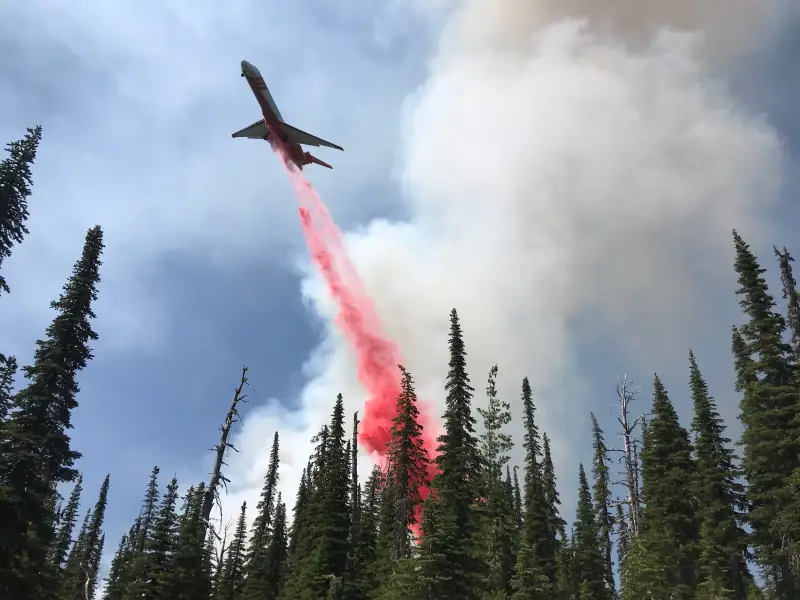
The FAA often puts a TFR around a wildfire to protect the aircraft fighting it, under 14 CFR 91.137. Inside, every aircraft, drones included, is barred unless it is flown by an agency working the fire. The National Interagency Fire Center's line, which the FAA repeats, says it plainly: If you fly, we can't.
A delay in the air lets a fire grow and puts firefighters, homes and people at risk. That is why the law punishes interfering with firefighting even where no TFR is in place:
- interfering with firefighting efforts on public lands is a federal crime, punishable by up to 12 months in prison;
- the FAA can fine a drone pilot who interferes with wildfire suppression, law enforcement or emergency response up to $20,000 under the statute, $26,116 after the yearly inflation adjustment.
Fire TFRs on the map are under Hazards and firefighting, in red while in force. Tap one for its floor and ceiling, and check again on the day you fly: a new fire brings a new TFR.
Agencies such as the U.S. Forest Service fly their own drones on fires. For anyone else, the FAA's way in is the Special Governmental Interest process, open to Part 107 pilots with a current certificate and to holders of a certificate of authorization; the FAA says typically only public safety agencies, first responders and organizations such as the media may be eligible.
How to check for TFRs before you fly
Look on the map, read the NOTAM, check your exact spot, and look again on the day you fly. The FAA says to always check NOTAMs before a flight.
- Open the map
Look at the map
Live FAA listPick your state or type your spot. Red is in force now, amber starts later. Note the NOTAM number of any TFR near where you plan to fly.
Read the NOTAM
tfr.faa.govOn the FAA TFR list, filter by state and open the TFR by its number in the NOTAM column. The full text has the exact area, the times, who may fly inside and the agency to call. The FAA updates the list in real time.
- Can I fly here?
Check your exact spot
B4UFLY, LAANCTFRs also show in the FAA's B4UFLY app for recreational flyers and in the LAANC apps. Can I fly here? checks one spot for TFRs, airspace, airports and the rest.
Look again before takeoff
Every flightA new TFR can appear after you planned, for a fire, a rescue or a VIP. If one covers your spot, do not fly there; to ask for permission, contact the agency named in the NOTAM.
What happens if you fly a drone in a TFR
The FAA investigates every reported TFR violation. The answer ranges from a warning to fines, the loss of a pilot certificate and, in security TFRs, criminal charges.
Most the FAA can fine an individual or a small business, per violation.
Most the FAA can fine a drone pilot for interfering with firefighting, police or a rescue.
In prison, a fine, or both, for knowingly or willfully violating national defense airspace, such as a stadium TFR.
Federal security agencies may disrupt, seize or destroy a drone that poses a credible threat.
The FAA's words: pilots who violate TFRs “can face sanctions ranging from warnings or fines to certificate suspensions or revocations”, and the sanction depends on the circumstances. For a company that is not a small business, the most per violation is $75,000.
Security TFRs carry more. A stadium TFR and the other airspace the FAA names national defense airspace are crimes to enter knowingly or willfully. The stadium NOTAM warns that pilots who do not comply may be intercepted, detained and interviewed by law enforcement, and that the Departments of Defense, Homeland Security and Justice may take action against a drone, up to destroying it.
If you find yourself inside a TFR by mistake, leave it by the shortest way and land. Then read the NOTAM before you fly there again.
Where these come from
FAA civil penalties: 49 U.S.C. 46301, amounts in 14 CFR 13.301 for violations on or after December 30, 2024. Interfering with wildfire suppression, law enforcement or emergency response: 49 U.S.C. 46320 ($20,000 in the statute). National defense airspace: 49 U.S.C. 46307, fines under title 18 and up to one year. Action against drones: 10 U.S.C. 130i and 6 U.S.C. 124n, as FDC NOTAM 0/0367 names them. Firefighting on public lands: the FAA's drones and wildfires toolkit.
Related tools and guides
A TFR is one check before a flight. These cover the rest.
Before you fly
The spot and the weather.
Where you may fly
Airspace and heights.
TFR questions and answers
What does temporary flight restriction mean?
A temporary flight restriction (TFR) is a NOTAM that closes a set piece of airspace to aircraft, drones included, for a set time, for safety or security: a wildfire, a VIP visit, a launch, a big game. It names who may still fly inside.
Can I fly my drone in a TFR?
Not without permission, and permission is rare. A drone may operate within a TFR only as its rule and NOTAM allow, and the way in is the agency in charge named in the NOTAM. For emergencies the FAA runs the Special Governmental Interest process: you must be a Part 107 pilot with a current certificate or hold a certificate of authorization, and send the Emergency Operation Request Form to the FAA's System Operations Support Center. The FAA says typically only public safety agencies, first responders and organizations such as the media may be eligible. For a recreational flyer, plan on no.
What happens if you accidentally fly through a TFR?
Leave it by the shortest way and land. The FAA investigates all reported TFR violations, and the sanction depends on the circumstances, from a warning or a fine to the suspension or revocation of a pilot certificate. In a security TFR, such as a stadium during a game, knowingly entering is also a crime.
What are the three types of temporary flight restrictions (TFRs)?
The FAA names three reasons for TFRs: natural disasters such as wildfires and hurricanes, certain major sporting events, and emergency or national security situations. By rule there are more kinds: disaster and hazard areas (91.137), Hawaii disasters (91.138), emergency air traffic rules (91.139), VIP visits (91.141), space operations (91.143), high barometric pressure (91.144), sporting events and air shows (91.145), security (99.7) and drone-only TFRs over big gatherings (49 U.S.C. 44812).
How big is a TFR, and how long does it last?
Each NOTAM sets its own area, floor, ceiling and times. A major sporting event TFR is normally 3 NM and 2,500 ft above the ground, an air show 5 NM, and the stadium rule 3 NM up to 3,000 ft. A Hawaii disaster TFR lasts up to 90 days unless extended, and a few, such as the Washington, DC rules, have no end date and stand until the FAA cancels them.
Do TFRs apply to drones under 250 grams?
Yes. Recreational flyers must comply with temporary flight restrictions whatever the drone weighs (49 U.S.C. 44809(a)(6)), and Part 107 pilots must comply with the TFR rules (14 CFR 107.47). The 0.55 lb (249 g) line matters for registration, not for TFRs.
Why are TFR times shown in UTC?
NOTAMs are written in UTC, also called Zulu time. This map shows each TFR's times in the local time where it is, with UTC beside it, so you can match them to the NOTAM text.
Does this map show every NOTAM?
No. It shows the TFRs on the FAA's TFR list. Other NOTAMs, such as those about airports and obstacles, are not on it; read them in the FAA's NOTAM search before you fly.
Sources
Named, not linked. Rules read Nov 9 to 14, 2026.
FAA pages
- FAA, Temporary Flight Restrictions (TFRs), drone pages, last updated March 10, 2025
- FAA, Stadiums and Sporting Events, last updated November 19, 2025
- FAA, Airspace Restrictions, last updated December 11, 2025
- FAA, Drones and Wildfires toolkit
- FDC NOTAM 0/0367, special security instructions for select sporting events, FAA TFR website
Regulations and law
- 14 CFR 91.137, 91.138, 91.139, 91.141, 91.143, 91.144, 91.145 (eCFR, November 9, 2026)
- 14 CFR 99.7, 107.47 and 13.301 (eCFR, November 9, 2026)
- 49 U.S.C. 44809, 44812, 46307 and 46320 (U.S. Code, 2024 edition)
Data on the map
- FAA TFR list, TFR shapes and TFR details, tfr.faa.gov, read by this site at most every 5 minutes
- U.S. Census Bureau TIGERweb state boundaries, for the state outlines
- U.S. Census Bureau 2025 Gazetteer Files, for the place search