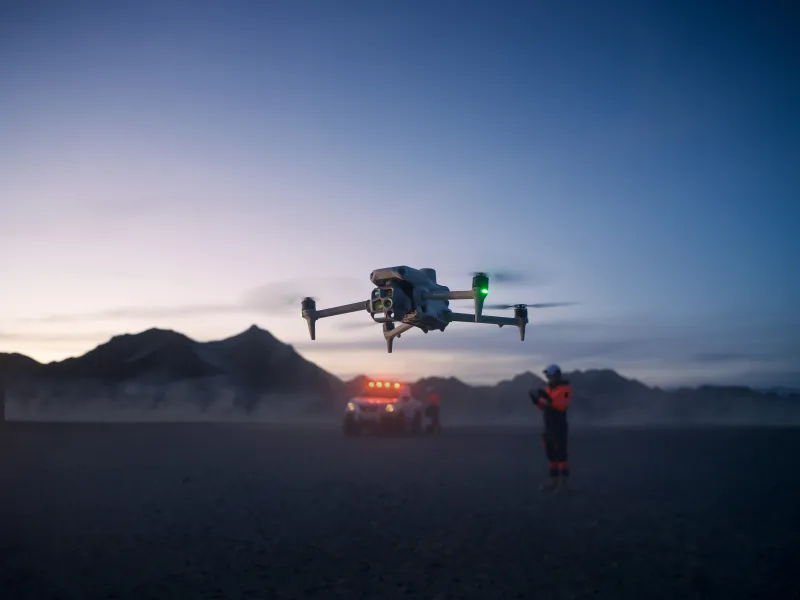
Can you fly a drone at night? FAA rules for drones flying at night
Yes, on each rulebook's terms: Part 107 asks for training after April 6, 2021 and a lit anti-collision light; flying for fun, your CBO's guidelines must cover night flight.
- Light seen from
- 3statute mi
- Part 107 training after
- Apr 62021
- Civil twilight, each side
- 30min
- Part 107 night waiver needed
- No
- FAA-recognized CBOs
- 4
Can you fly a drone at night? FAA drone rules for Part 107 and recreational drone operators
A Part 107 pilot may fly at night without a waiver once their knowledge test or training was completed after April 6, 2021, with a lit anti-collision light visible for at least 3 statute miles. Flying for fun, you may fly at night only if the safety guidelines of the community-based organization you follow address night flight.
The Federal Aviation Administration (FAA) has two sets of drone rules for small drones.
- Part 107
Part 107 (14 CFR part 107) covers commercial drones and every flight that is not strictly for fun, and it has its own night rule.
Night rule - Flying for fun
The recreational exception of 49 U.S.C. 44809 covers flying for fun, and it does not mention night at all: the safety guidelines of the community-based organization (CBO) you follow decide whether, and how, you may fly at night.
Your CBO decides
Two rulebooks answer this question, and this page keeps them apart: Part 107 for commercial drones and any flight that is not only for fun, and the recreational rules for flying for fun. Then it shows when night starts, what the makers' manuals say about lights, and what the rules ask a drone in the night sky to show.
| Topic | Flying for fun | Part 107 |
|---|---|---|
| Who may fly at night | None: the eight conditions of 44809(a) do not mention night or lights. No night flight unless the CBO safety guidelines followed address night flight.49 U.S.C. 44809(a); AC 91-57D 3.3.2 | Initial knowledge test or training under 107.65 completed after April 6, 2021; recurrent training from before that date does not count.14 CFR 107.29(a)(1); FAA Part 107 Airspace Authorizations |
| Lights at night | Strongly recommended: anti-collision lights seen from 3 statute miles showing orientation and flight path, or flight in a sufficiently lit area.AC 91-57D 3.3.2.5 | Lighted, visible at least 3 statute miles, flash rate sufficient to avoid a collision.14 CFR 107.29(a)(2) |
| Keeping the drone in sight | Flyer or a co-located visual observer keeps the drone in sight, including at night.49 U.S.C. 44809(a)(3); AC 91-57D 3.3.2.5 | Light or telemetry alone does not meet VLOS; a smaller operating area expected.AC 107-2A 5.9.3 |
| Controlled airspace near airports | Night authorization can be requested through LAANC.FAA Airspace Authorizations for Recreational Flyers | Airspace authorization still needed; FAADroneZone authorizations available day and night.FAA Part 107 Airspace Authorizations |
| Remote ID | No time-of-day condition.14 CFR 89.105 | No time-of-day condition.14 CFR 89.105 |
Night flying under each rulebook: the recreational rules (49 U.S.C. 44809) and Part 107 (14 CFR part 107), each in its own cell, for the topics both speak to.
When night starts: sunset, civil twilight and the FAA's night
Read together, Part 107 asks for the anti-collision light from sunset to sunrise, and for the training at night.
- Night
The FAA defines night in 14 CFR 1.1 as “the time between the end of evening civil twilight and the beginning of morning civil twilight, as published in the Air Almanac, converted to local time.”
Light + training - Civil twilight
Part 107 sets its own civil twilight for the light rule: outside Alaska, the 30 minutes before official sunrise and the 30 minutes after official sunset; in Alaska, the period of civil twilight the Air Almanac defines (14 CFR 107.29(c)). FAA Advisory Circular 107-2A gives the same 30 minutes for the continental U.S.
Light - Between the two
The two definitions need not end on the same minute, and no FAA document we read says which one governs the minutes between them. So this page reads them together: under Part 107 the anti-collision light is needed from sunset to sunrise, in civil twilight and at night, and the training condition applies at night as 14 CFR 1.1 defines it.
Sunset to sunrise
Our drone weather forecast marks each forecast hour Day, Twilight or Night from the sun's position at your spot, and its best daylight window counts daylight hours only.
- Day
- No light needed
- Civil twilight
- Light
- Night
- Light + training
Civil twilight: 30 minutes before sunrise and after sunset outside Alaska; in Alaska, the Air Almanac's period.
Can I fly here?
Our Can I fly here? tool works out sunrise, sunset and civil twilight for the spot and time you enter, and for a flight between sunset and sunrise it says what that flight needs: the lit anti-collision light under Part 107, or guidelines that cover night flight when you fly for fun.
Can I fly here?Part 107 night flying: the required training
No night waiver since April 2021: a knowledge test or training completed after April 6, 2021, and a lit anti-collision light.
- At night
No waiver needed: a test or training completed after April 6, 2021, and the lit light.
No waiverThe exact rule
… no person may operate a small unmanned aircraft system at night unless … (1) The remote pilot in command of the small unmanned aircraft has completed an initial knowledge test or training, as applicable, under § 107.65 after April 6, 2021; and (2) The small unmanned aircraft has lighted anti-collision lighting visible for at least 3 statute miles that has a flash rate sufficient to avoid a collision.
14 CFR 107.29(a), Operation at nightWhat it means: you may fly at night without a waiver once your knowledge test or training was completed after April 6, 2021, and while the drone shows the lit anti-collision light.
- In civil twilight
The training condition is written for night only; for civil twilight the rule asks for the light alone (107.29(b)).
Light only - The test since 2021
AC 107-2A says night privileges come either from the initial knowledge test, which has questions on night physiology and night visual illusions, or from the recurrent training, which covers the same topics. Night operations joined the initial test, “Unmanned Aircraft General - Small” (UAG), on April 6, 2021, so passing it on or after that date meets the condition. What the test covers and how to book it are in our Part 107 exam guide.
Counts - Certificated earlier
A pilot certificated before then completes the online recurrent training the FAA published on April 6, 2021; in the FAA's words, “Recurrent training taken before April 6, 2021 does not meet the requirements”.
Train again - Current today
The recency rule, 14 CFR 107.65, asks every remote pilot for a test or training within the previous 24 calendar months, so a Part 107 pilot who is current today has met the night condition. That follows from 107.65; no FAA page says it in those words.
Covered
Due for recurrent training?
Our Part 107 renewal guide covers the free recurrent course.
Part 107 renewalAnti-collision lights for a night drone flight
At night and in civil twilight a Part 107 drone shows a lit, flashing light seen from 3 statute miles. You may dim it, never switch it off.
- How bright
At night and in civil twilight a Part 107 drone needs lighted anti-collision lighting visible for at least 3 statute miles, with a flash rate sufficient to avoid a collision (14 CFR 107.29(a)(2) and (b)).
3 statute mi - Dimming
Dim it for safety, never switch it off. The FAA's example for dimming: a bright light or strobe very close to the pilot could stop the pilot judging the drone's position, speed, attitude or altitude (AC 107-2A, 5.7.2.2).
Dim, not offThe exact rule
The remote pilot in command may reduce the intensity of, but may not extinguish, the anti-collision lighting if he or she determines that, because of operating conditions, it would be in the interest of safety to do so.
14 CFR 107.29(a)(2) and (b), Operation at nightWhat it means: at night and in civil twilight you may dim the light for safety, never switch it off.
- Which light
The rule names no particular light. AC 107-2A lets the pilot rely on the manufacturer's statement that a light is visible for 3 statute miles, but the pilot “ultimately remains responsible” for checking that it works, can be seen that far and flashes fast enough at the site (5.7.2).
Check it - By day
By day, 107.29 asks for no anti-collision lights, and a pilot may choose to use them.
Optional
What changed in 2021, and what a night waiver still covers
Since 2021 Part 107 pilots fly at night without a waiver. A waiver today can cover only the light rules.
- Until 2021
The 2016 small drone rules did not permit night operations without a waiver. The rule “Operation of Small Unmanned Aircraft Systems Over People” (86 FR 4314, January 15, 2021) changed that. It took effect on April 21, 2021, and its certification and training sections (107.61, 107.63, 107.65, 107.73 and 107.74) on April 6, 2021 (86 FR 13630). The FAA's airspace authorization page now says the rule “allows for routine operations of small UAS at night without a waiver.”
No waiver now - Old waivers
Night waivers issued before April 21, 2021 could not be used for night flight after May 17, 2021, and waivers from 107.29 issued before March 16, 2021 ended that day (107.29(d)).
Ended - Waivers today
Today a waiver can cover only the light rules, 107.29(a)(2) and (b); the training condition is not on the list of waivable sections (14 CFR 107.205(b)). The FAA's waiver page lists “Fly a small UAS at night or during periods of civil twilight without anti-collision lighting”. An application for night or twilight must explain how the added risk is mitigated, “or you may be restricted to daylight operations only”, and the FAA aims to decide within 90 days.
Lights only
No waiver for the training
The training condition cannot be waived: a Part 107 night flight always needs a knowledge test or training completed after April 6, 2021.
| Rule | When it applies | What it says |
|---|---|---|
| The light in civil twilight | Civil twilight | Same light as at night; no training condition in this paragraph.14 CFR 107.29(b) |
| When civil twilight is | Civil twilight | Outside Alaska: 30 minutes before official sunrise to sunrise, and sunset to 30 minutes after; Alaska: Air Almanac.14 CFR 107.29(c) |
| When night is | Night | End of evening civil twilight to beginning of morning civil twilight, per the Air Almanac, local time.14 CFR 1.1 |
| Dimming the light | Night and civil twilight | May be reduced for safety, may not be switched off.14 CFR 107.29(a)(2), (b) |
| Checking the light | Night and civil twilight | Pilot may rely on the maker's statement but remains responsible that the light works, is visible 3 statute miles and flashes fast enough.AC 107-2A 5.7.2 |
| Lights by day | Day | Not required.AC 107-2A 5.7.2.2 |
| What a waiver can cover | Night and civil twilight | Only the light rules (107.29(a)(2) and (b)) are waivable; the training condition is not on the list.14 CFR 107.205(b); FAA Part 107 Waivers |
| Night waivers from before 2021 | Night | Waivers issued before April 21, 2021 not valid for night after May 17, 2021.14 CFR 107.29(d) |
| Flying over people | Night | Categories and limits unchanged at night.AC 107-2A 8.14 |
Part 107's other night and civil twilight rules, one row each, with the hours each applies to.
Flying drones at night for fun: what the CBO guidelines say
The law says nothing about night. The guidelines you follow must address night flight, or you do not fly at night.
- The law
The recreational exception lists eight conditions, and none mentions night, twilight or lights (49 U.S.C. 44809(a)). One of them is that you follow the safety guidelines of an FAA-recognized community-based organization; you need not join it.
Silent on night - Your guidelines
FAA Advisory Circular 91-57D sets the limit: you may only fly the kinds of operations your guidelines address, so no night flight unless they address night flight.
Must cover night - In sight
Line of sight applies at night too: you, or a visual observer next to you, keep the drone in sight.
In sight - Lights
For those guidelines the FAA strongly recommends anti-collision lights seen from 3 statute miles, arranged so you can tell the drone's orientation and flight path, or, instead, flight in an area lit well enough to keep the drone in sight and see hazards (AC 91-57D, 3.3.2.5). For the eye's limits at night the circular points to Chapter 11, Night Operations, of the FAA's Airplane Flying Handbook.
Recommended
The FAA recognizes four CBOs, and each writes its own night rules.
| Whose rule | What it says at night |
|---|---|
| Academy of Model Aeronautics (AMA) | Anti-collision lighting seen from 3 statute miles unless a hazard or distraction; lights showing attitude and direction; hand-held light inadequate; AMA training required.AMA Member Safety Program Handbook, March 2023 edition |
| Flite Test Community Association (FTCA) | Anti-collision lighting seen from 3 statute miles plus orientation lighting; not needed in sufficiently lit areas such as stadiums; lights must dim or switch off.Flite Test Community Association Safety Guidelines |
| FPV Freedom Coalition (FPVFC) | VLOS at night; ambient light enough to see the aircraft without visual aids; no light rule in the night text.FPV Freedom Coalition Safety Guidelines, last revised May 2023 |
| STEM+C Inc. | Not read: we could not open its safety guidelines, so this page states none of its rules.STEM+C Inc. |
| Washington, D.C. area (SFRA) | No recreational flights at night, as 14 CFR 1.1 defines night, in the Special Flight Rules Area.FAA NOTAM FDC 5/7224 |
Flying for fun at night: each FAA-recognized community-based organization's night guidelines, as read on November 14, 2026, and the night rule of the Washington, D.C. area.
Do drones come with anti-collision lights? What makers' manuals say
None of the 13 makers' manuals we read names a built-in anti-collision light or says how far its lights can be seen.
We searched the makers' manuals of the drones below for an anti-collision light, a strobe, a beacon, an auxiliary light, LEDs and any statement about night or daytime flight. None names a built-in anti-collision light or says how far any of its lights can be seen, so none states the 3 statute miles Part 107 asks for.
In DJI's manuals “Wi-Fi Beacon” is the Remote ID broadcast method, not a light either.
| Drone | Lights the manual names | What it says about night |
|---|---|---|
| DJI Neo | One status indicator on topUser manual v1.2, 2024.11 | “Only fly DJI Neo in the daytime.” |
| DJI Neo 2 | A status indicatorUser manual v1.2, 2025.12 | “Only fly the aircraft in the daytime.” |
| DJI Flip | Aircraft status indicatorsUser manual v1.0, 2025.01 | “Only fly the aircraft in the daytime.” |
| DJI Avata 2 | One status indicator on topUser manual v1.0, 2024.05 | “Only fly the aircraft in the daytime.” |
| DJI Mini 3 | Two status indicatorsUser manual v1.2, 2024.01 | No daytime or night statement found |
| DJI Mini 3 Pro | Two status indicators that blink green after the motors startUser manual v1.6, 2024.01 | “Lighting requirements vary depending on the region.” |
| DJI Mini 4K | One status indicatorUser manual v1.0, 2024.04 | No daytime or night statement found |
| DJI Mini 4 Pro | Status indicators that blink green after the motors start, “for conspicuity purpose”, to show it is a UAV; a bottom auxiliary light that only helps the downward vision systemUser manual v1.4, 2024.06 | It can fly by day or night, but its vision systems are unavailable at night |
| DJI Mini 5 Pro | Status indicators that blink green after the motors start; a bottom auxiliary light for the vision systemUser manual v1.0, 2025.09 | It can fly by day or night, but its vision system is unavailable at night |
| DJI Air 3S | Front LEDs that blink green and status indicators that blink red and green after the motors start: green shows it is a UAV, green and red show heading and position. On Auto the front LEDs switch off while taking photos and videosUser manual v1.0, 2026.04 | It can fly by day or night, but its vision system is unavailable at night |
| DJI Mavic 4 Pro | Front LEDs that, on Auto, switch off while taking photos and videosUser manual v1.2, 2025.09 | It can fly by day or night, but its vision system is unavailable at night |
| Antigravity A1 | A flight status indicatorUser manual V2.0, 2026-11-06 | Fly with caution at night: the vision system does not work in low light |
| HOVERAir X1 PRO and PROMAX | The “Beacon” of its quick start guide is a control device, not a lightQuick Start Guide V1.0 | “Flying in low-light conditions is prohibited”: ground lit under 15 lux, for example at nightDisclaimer and Safety Instructions V2.0 |
What the makers' own manuals say about lights and night flight, read November 14, 2026. Each manual's version is under the drone's name.
Night drone flights in controlled airspace
Night does not change the airspace rules.
- Part 107
A Part 107 night flight in controlled airspace also needs a valid airspace authorization, and FAADroneZone authorizations are available for day and night.
Authorization - Flying for fun
Recreational flyers can request night authorization in controlled airspace through LAANC.
LAANC
Rules that still apply to a night flight: visual line of sight, the visual observer, 400 feet, Remote ID
The FAA's own summary for flying at night: drone pilots still keep the drone in sight, stay below 400 feet and avoid restricted or prohibited airspace.
- In sight, Part 107
AC 107-2A adds that a Part 107 pilot cannot rely only on the anti-collision light, the controller's telemetry or both to keep visual line of sight, and it expects a smaller operating area in almost all night cases (5.9.3).
Smaller area - In sight, for fun
Flying for fun, the law lets you or a visual observer co-located with you keep the drone in sight, and AC 91-57D says that holds “including when operating at night” (49 U.S.C. 44809(a)(3); AC 91-57D 3.3.2.5).
In sight - Over people
Flying over people works the same at night: its categories and limits do not change (8.14).
Unchanged - Remote ID
The Remote ID rule has no time-of-day condition: 14 CFR 89.105 applies to every flight of a drone it covers.
Every flight
More on each in our guides to how high a drone can fly and Remote ID.
Drones flying at night in the sky: what the lights mean and who to tell
A Part 107 drone at night shows a lit, flashing light, and drones that must comply with Remote ID broadcast where they are. The FAA asks the public to report unauthorized drone flights to local law enforcement.
- Its lights
A drone flown under Part 107 at night or in civil twilight must show a lit, flashing anti-collision light visible for 3 statute miles (14 CFR 107.29). For recreational flyers the AMA's and the FTCA's guidelines ask for one too, and the FAA recommends lights arranged so the flyer can tell the drone's orientation and flight path; the AMA asks for lights that show its attitude and direction of flight.
Flashing - Its broadcast
Lights are not the only signal. Drones that must be registered, or are, “including those flown for recreation, business, or public safety”, must comply with Remote ID: in flight they broadcast identification and location that “can be received by other parties”. Remote ID helps the FAA, law enforcement and other federal agencies find the control station of a drone flying unsafely or where it is not allowed.
Remote ID - Police drones
Police and other public safety agencies fly drones either under Part 107 or as public aircraft with a certificate of waiver or authorization (COA), and the FAA pages we read give public aircraft no night rule of their own. No FAA page we read says how to tell a police drone from another drone by its lights.
No own rule - Who to tell
The FAA receives more than 100 reports of drone sightings near airports each month and publishes them by quarter. It “encourages the public to report unauthorized drone operations to local law enforcement”.
Tell police
Reading the lights
Under Part 107: a lit anti-collision light that flashes, seen from 3 statute miles. Status lights come on too: on the DJI Air 3S, green shows it is a UAV, and green and red show heading and position.
Related pages
Where and when to fly, the certificate a night flight needs, and the rules that apply day and night.
Where and when
Your certificate
Flying at night: questions and answers
Is it legal to fly a drone at night?
Yes, on each rulebook's terms. Under Part 107 it's legal without a waiver once your knowledge test or training was completed after April 6, 2021, with a lit anti-collision light visible for 3 statute miles. Flying for fun, it's legal only if the CBO guidelines you follow address night flight.
Can Part 107 pilots fly at night?
Yes, without a waiver, if their initial knowledge test or 107.65 training was completed after April 6, 2021 and the drone shows a lit anti-collision light visible for at least 3 statute miles. Recurrent training taken before April 6, 2021 does not count.
Do recreational flyers need lights at night?
The statute does not say; the guidelines you follow do. The AMA and the FTCA require anti-collision lighting seen from 3 statute miles, the FTCA not in areas lit well enough such as stadiums; the FPV Freedom Coalition asks for enough ambient light to see the drone. The FAA strongly recommends that guidelines call for lights (AC 91-57D).
Can you fly a drone at night without lights?
Under Part 107, only with a waiver of the light rules, 107.29(a)(2) and (b). Flying for fun, it depends on your guidelines: the FTCA allows it in sufficiently lit areas, the FPV Freedom Coalition sets no light rule, and the AMA requires lights unless they are a hazard or distraction to the operator.
Is there an app that shows when I can fly a drone at night?
Our Can I fly here? tool works out sunset and civil twilight for your spot and time and says what a night flight there needs. Our drone weather forecast marks each hour Day, Twilight or Night.
What do drones look like at night?
A drone flown under Part 107 at night shows a lit, flashing anti-collision light visible for 3 statute miles. Drones also carry status lights: DJI's Air 3S manual says its front LEDs blink green and its status indicators red and green once the motors start.
Sources Named, not linked.
Documents are named, not linked. Each was read on November 14, 2026, and the page was last checked against them on November 14, 2026.
Law and regulations
- 14 CFR 1.1, 107.29, 107.65, 107.205 and part 89 (eCFR, current as of November 12, 2026)
- 49 U.S.C. 44809, Exception for limited recreational operations of unmanned aircraft: (a) (U.S. Code release point 119-142)
- FAA final rule, Operation of Small Unmanned Aircraft Systems Over People, 86 FR 4314 (January 15, 2021), and its delay and correction, 86 FR 13630 (March 10, 2021)
- FAA NOTAM FDC 5/7224, Washington, D.C. Special Flight Rules Area (issued September 3, 2025)
FAA pages and guidance
- FAA Advisory Circular 107-2A (February 1, 2021): 5.7, 5.9.3 and 8.14
- FAA Advisory Circular 91-57D (June 24, 2025): 3.3.2
- FAA, Part 107 Airspace Authorizations (updated October 1, 2026)
- FAA, Part 107 Waivers (updated October 29, 2026)
- FAA, Getting Started: Flying at Night
- FAA, FAA-Recognized Community Based Organizations (updated May 5, 2026)
- FAA, Airspace Authorizations for Recreational Flyers
- FAA, Changes to Testing for a Remote Pilot Certificate (April 5, 2021)
- FAA newsroom, Recurrent Training Courses for Drone Pilots Available Online (April 8, 2021)
- FAA, Remote Identification of Drones
- FAA, Drone Program for public safety and government
- FAA, UAS Sightings Report (updated October 2, 2026)
Community-based organizations
- Academy of Model Aeronautics, Member Safety Program Handbook (March 2023): night flying
- Flite Test Community Association, Safety Guidelines: night operations
- FPV Freedom Coalition, Safety Guidelines (last revised May 2023): night operation requirements
Makers' manuals
- DJI Neo User Manual v1.2, DJI Neo 2 User Manual v1.2, DJI Flip User Manual v1.0 and DJI Avata 2 User Manual v1.0
- DJI Mini 3 User Manual v1.2, DJI Mini 3 Pro User Manual v1.6, DJI Mini 4K User Manual v1.0, DJI Mini 4 Pro User Manual v1.4 and DJI Mini 5 Pro User Manual v1.0
- DJI Air 3S User Manual v1.0 and DJI Mavic 4 Pro User Manual v1.2
- Antigravity A1 User Manual V2.0
- HOVERAir X1 PRO Quick Start Guide and Disclaimer and Safety Instructions (Zero Zero Technology)